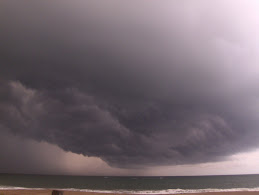
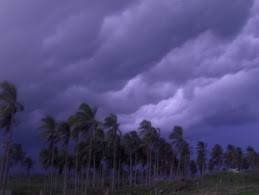
Last night there was the most intense thunderstorm I've been through. It started an hour before sunset with dense dark thunderheads rolling slowly towards the house from the south. i sat outside in the screened room to watch the lightning, and it was a spectacular show with lightning bolts shooting into the ocean and lighting the entire sky. However, at one point a bolt of lightning struck the ground somewhere between Michael and Sylvia's property and our house. I jumped high, ran inside and shut the door, and proceeded to watch the show from the safety of my bed! It lasted for hours and there were several additional strikes very close to the house. I finally fell asleep and woke up to a clear, humid day. It looks more are coming this evening.

Tuesday, July 22, 2008


Long overdue posts . . .


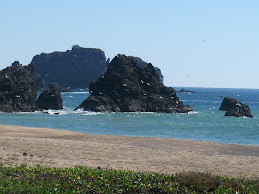
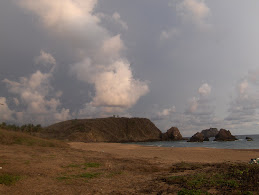
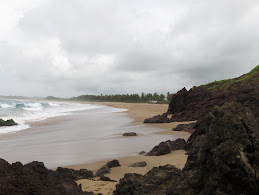
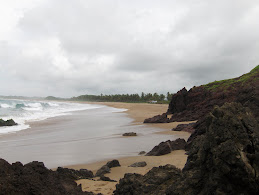
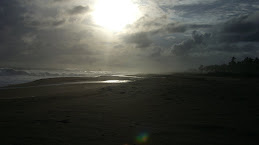
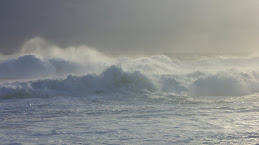
Calm has settled on us. After the two days of Tropical Storm Douglas, the ocean is still pushing in big waves, but the ocean height has receded to near normal and the offshore rocks are once again visible above the ocean. It is bright day with scattered large clouds; an unusually beautiful day, with a blue tinge to everything (check out the photos). The air is sparkling clear, glistening with the blueness of the sky and ocean reflected all through the atmosphere. As I look around, everything is not the same; it is clear that the beach has taken the brunt of the storm: What was once a rolling, undulating beach, with four distinct levels, is changed. The constant pounding of the big waves, combined with the high water, washed away the undulating portion of the beach and the flat area above it, creating a long, wide, flat beach. Unbelievable!


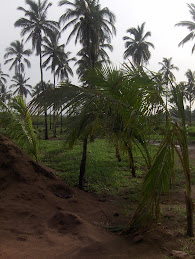
The vegetation seems unchanged, but trees were knocked down and snags (dead trees) were also felled. The animals seem to have fared well; we did not find dead birds, or washed up fish or other sea life. The sea life and other wildlife all seem to have their own unique way of coping with the storm. The rain did a great deal of good, except where it flooded in pueblos and cities, recharging the dry, rock-hard soils, which were so dry that the rivers hardly rose after the many inches of rain that fell. Most of the rain soaked into the ground.
July 4, 2008


Moyos start their journey in the adjacent forested hill, making a long and dangerous trek to the ocean. As you can imagine, crossing roads is their most difficult part of their trip. After mating, the female spends four months in her burrow in gestation. When conditions are right, heavy rain and the highest tide of the month, they emerge out of their burrows and begin their journey. They need the high tide, with a long wash of water up the beach, so they can lay their eggs in the water without getting washed out. They come out by the millions all along the coast of Jalisco, and they were all over our beach, by the hundreds, crawling everywhere, in groups of 5, 10, 20, all walking away from the ocean towards the laguna (lagoon).
July 11, 2008
Beach slowly re-heals
The beach is beginning to heal after the pounding of Tropical Storm Douglas. No longer is it a long, flat beach, but now the waves have created a step drop-off where they crash, as existed before the storm. The steep drop-off has started the reformation of the undulating dunes that was a major characteristic of our beach.
Not long after writing the above note, we were pounded for two days with giant waves from hurricane Bertha. At the closest it was 260 miles west of Manzanillo. Once again the beach is wide and flat. During the summer, this beach is evidently very dynamic, changing constantly under the battering from off-shore storms. I would hate to see one of these storms come on shore!
July 14, 2008
Summer Rains
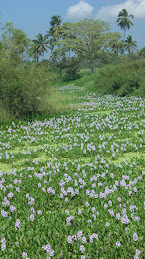
Spring is here in Tenacatita. It may feel like summer but the trees, shrubs, and herbaceous plants are just now starting to green up. The rains from the big storm and several other thunderstorms have produced a flush of life, with plants coming to life creating a lush green carpet covering the mountains, hillsides, and pastures. It seems to have happened overnight, hillsides that were dry brush and leafless trees have changed to dense green, impenetrable jungle. Many trees and other plants are blooming, which delightfully brings out many beautiful, multi-sized and –colored butterflies. Summer, with its life giving rain, so quickly created on our hillsides a natural garden of blossoming plants, filled with an array of colorful breeding birds and insect life.
The summer rains brought us the march of the Moyos , a serendipitous, totally fascinating experience. Now we excitedly (or fearfully) wait for the march of the tarantulas, which we are told will happen this summer. The summer rains are a constant here in Tenacatita, and it is a joyful event as is seen in the attitudes of the local people who do not let the rain stop their daily routines, and by the myriad adaptations of plants and animals to the cycles of the rain. The winter months here in Tenacatita are beautiful, with mild warm weather, but the intensity and diversity of life found in this place is only fully expressed with the summer rains.
July 15, 2008
Summer is a Poor Fishing Season
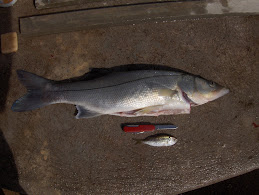
Fishing has been very, very slow. Water conditions seem fine to me, but I have seen few baitfish or swarming schools of feeding fish, nor diving water birds. I caught one needlefish, lost two others, and caught a small 1.5 lb jack. Needlefish seem to be the most common fish biting now. Yesterday, I saw a boil of bait fish and as I watched them a four foot needlefish came shooting 4 feet out of the water with a fish in its long, toothed snout! What a sight! A friend, Joe, tells me that soon the roosterfish should be showing up along the shore, so I keep an eye on the water anxious for some action. But most locals say that fishing will not improve until September when the boca del laguna (mouth of the lagoon) breaks open from the rains (it is blocked by wave created sand dunes) and lets loose lots of fish, especially snook. Snook grow up in mangrove swamps, the laguna, and this type habitat is essential breeding and rearing habitat. Very likely, summer is breeding season for local game fish, and they won’t show up until the breeding season ends (September?).
July 17, 2008
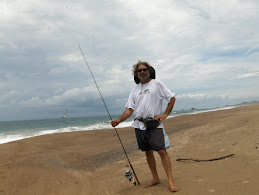
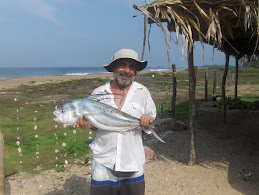
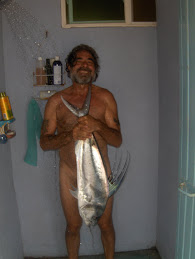
Joe was correct; the roosterfish are coming close to shore. Today I landed a 10 lb roosterfish (gallo in Spanish). I had three strikes, where I wasn’t able to set the hook, when suddenly I got a sold hit from this beautiful roosterfish. It gave a good fight for 15 minutes, making short runs, but mostly staying in the surf, where it was hard for me to land her (sex determined during cleaning).


Saturday, July 19, 2008
Sharon Leaves
Sad news for me! Sharon left today for Los Estados Unidos, the US. She wasn´t very happy down here in the heat and humidity and spent much of her time in the air conditioned bedroom. We did go in the ocean and boogie board, and a few other things, but the heat was stifling.
Tuesday, July 8, 2008
Tropical Storm Douglas

Only the most hardy and adaptable can survive in a region so mutable, yet the area between the tide lines is crowded with plants and animals. In this difficult world of the shore, life displays its enormous toughness and vitality by occupying almost every conceivable niche. Visibly, it carpets the intertidal rocks; or half hidden, it descends into fissures and crevices, or hides under boulders, or lurks in the wet gloom of sea caves. Invisibly, where the casual observer would say there is no life, it lies deep in the sand, in burrows and tubes and passageways. It tunnels into solid rock and bores into peat and clay. It encrusts weeds or drifting spars or the hard, chitinous shell of a lobster. It exist minutely, as the film of bacteria that spreads over a rock surface or a wharf piling; as spheres of protozoa, small as pinpricks, sparkling at the surface of the seas; and as Lilliputain beings swimming through dark pools that lie between the grains of sand.
June 30, 2008
On Being a Beach Bum
Living the life of a beach bum: spending all my time on the seashore, chasing hot California girls, fishing and eating my catch - a romantic life! Growing up in New York I thought living in California and hanging on the beach would be a fun exciting life, and one that I had hoped to experience. In my young mind I envisioned all night beach parties with bonfires, music, drinking, and of course lots of attractive California girls. Days were spent recuperating and enjoying the hot sunny beaches and staying cool in the shade of a coconut tree and swimming in the ocean. I‘m not sure where the money was suppose to come from but for some reason I never imagined working. Of course, these were the ideals of a younger person growing up in what I thought was boring New York and being raised by strict Italian parents. Now that I am nearly 60 and live part-time on the Pacific seashore of central Mexico, I do not miss the imagined bonfires with loud music and fun parties; but I do take tequila and beer in moderation, and lucky for me, my wife just happens to be a hot California girl.
I find coastal living to be so much more than I envisioned as a young man. Living on the beach today, without the preoccupations of a young person to always be doing, going, and chasing; having an abundance of energy and exuberance that needs to be spent on youthful endeavors, I enjoy my quiet time when I can. I contemplate, observe, smell, and touch my new environment. Living only 100 yards or so, depending on the tide, from the waters edge, I am continually awed by the incredible, raw power of and variety of life in the Pacific Ocean. The constant waves crashing thunderously on the beach are both soothing and a source of constant awareness of the closeness and power of the ocean. At nighttime lying quietly in bed, I can feel the house vibrate when an exceptionally large wave crashes; in my half-sleep, I wonder how close the wave is to the house? Is there a bigger one behind it? The winds are also a constant on our beach with a light offshore breeze starting at daybreak and then swinging to the northwest and increasing as the day progresses. By afternoon we have a strong wind that often creates white caps; and by dusk it is quiet again. We also get south/southwest winds, which are generally associated with storms and rain.
In my mind, a beach bum leads a simple, carefree life, while living on the beach and eating out of the ocean. So how am I doing in living this life style . . .
On being a beach bum’s wife (a response from Sharon)
The truth is: The beach bum does chase his one attractive California girl, more than he watches the waves or the beach creatures. And he does drink beer and tequila. He may have waited till he was 60 but now he is making up for lost time. (This paragraph was added by Sharon).
July 3, 2008
Tropical Storm Douglas
In the late afternoon of July 1 the beginning of Tropical Storm Douglas began here in Tenacatita. It started as a stiff wind and dark clouds rolling in from the south/southwest. Within the hour, the winds increased and the rains began. Over the next few hours, as dark set in, the winds increased to a point were they were making an eerie howling sound. During the night we could hear the wind and rain beating against the house, and while lying huddled quietly together in bed, we could hear numerous thudding sounds outside, but we didn’t know what it was. At one point, a five gallon bucket left on the roof by the workers started rolling around making loud thudding sounds on the roof until finally it blew off and landed with a loud crash in the garden next to the bedroom. This spooked us! And then there was the ocean, with it’s loud crashing waves, glowing white and foamy in the darkness. We both slept fitfully that night.
 Clean-up of Tenacatita Beach
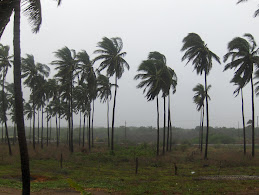
We awoke to the same sounds that we went to sleep with: howling, shrieking winds, rain beating against the house, and thunderous crashing waves. We dressed and went outside under our ramada to experience the storm we slept through and was still ongoing. It was an incredible experience of sight and sound: the wind strength was such that all the branches on every palm tree for as far as you could see were bent straight out, waving wildly, and facing in the same direction. We could see giant palm branches sailing through the air and the sound of coconuts falling to the ground all around. Beach litter, plastic bottles, large chunks of Styrofoam, tangled pieces of rope and fishing nets, where flying up the beach faster than a person could run. The rains fell in torrents, blowing sideways in dense, gray sheets, reducing visibility to tens of feet. Rivulets of water started flowing from the top of the sand dune, and coalesced into small streams running down our driveway and forming a small lake at the bottom next to the main road. We walked the beach at high tide, keeping a respectable distance from the breakers, and were awed by how much higher the ocean was from normal; there was an obvious ocean surge that was intense and scary. The ocean was a wild mess, with breakers crashing one after another, with no space between them; they were violent, churning and tossing themselves into a giant roiling, foaming surf that rushed far up the beach, ending as huge piles of suds that were caught by the winds and hurled down the beach along with the litter.
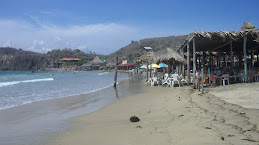
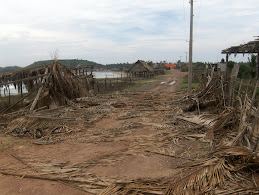
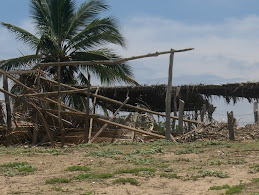
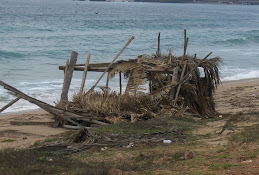
The storm never hit land here, staying out at sea. Yet it was a powerful, dangerous storm, and caused us much worry. Here on our beach, which is open ocean, at high tide the rushing waves reached to the bottom of the vegetation on the dune that our house sits on, but never was our house threatened by ocean waves. We did however find two small water leaks in our roof, and for the most part our house is strongly constructed. Not everyone fared as well as us: in Tenacatita there was considerable damage go Palapa roofs which were blown away or ripped to pieces. There was also water damage from the ocean surge that washed away tables and chairs from the restaurant, and in all the beach restaurants the water washed away sand, or deposited sand where unwanted. Of course, everyone had something blown away never to be seen again, and every leak in a roof or wall was revealed! The storm caused much flooding in La Manzanilla and in Melaque, which you can read about and see pictures off in Sharon‘s blog page: http://www.keepupwithsharon.blogspot.com. For those of us from Tenacatita to Emiliano Zapata, the storm caused a 34 hour power outage. It was a storm to remember.
“That the sea, with its multiform and mysterious hosts, its savage and senseless rages,” comfortably serves as a divine metaphor. Modified from the short story, Lifeguard, by John Updike.
Friday, June 27, 2008
Our first week at home in Tenacatita
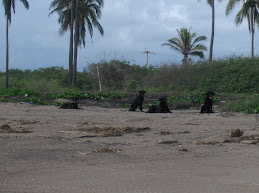
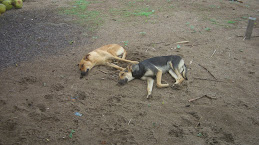
A friend, Tia, recently asked in an email how the beach dogs are doing now that it’s three months since being spayed. Of course I’ve seen the dogs, they showed up the evening we arrived. Pup ran up first followed by Scarlet and Shy (the female that lost her 10 pups). The dogs look healthy and spry, and seem happy, although they are skinny with their ribs showing through. Sadly missing from the group is Barky, the dog with the top half of both ears cut off., which doesn’t mean she isn’t around,, after all we’ve only been here 5 days, and she is somewhat of a loner. We will wait and see. I never knew Shy, as she was feeding pups over in Tenacatita so she didn’t come over to our beach. But now that she’s hanging with Pup and Scarlet she takes part in breakfast, dinner and treats here at our house.
We didn’t have food for them when we first arrived, but we drove to Melaque on Monday and bought some dog food. When we feed them regularly, they stay around all day sleeping in the shade, and barking at anyone and anything that comes to close to their new territory, our house and yard. I’m sure after three months of two good meals a day from us and whatever they can scrounge they will be healthier and happier. After we leave, Mike, will soon be down and will take over feeding them. He has being caring for the dogs for a long time and this probably attributes to their being alive.
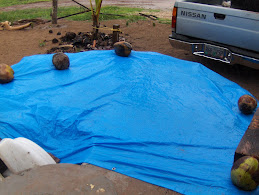
Our first week has been largely spent on organizing our house, which meant opening and emptying all our boxes. I can’t believe how much stuff we have already accumulated. We have kitchen stuff to stock a commercial kitchen; bathroom stuff to last a lifetime; and enough towels to dry an army; and books, books, and more books! We also needed to shop in Manzanillo, which is a 1.5 hrs drive, to find some shelving for the various rooms, and very importantly to find a cell phone and plan so we can economically call the States. On the drive back we stopped at some colorful fruit stands along the highway and bought a bunch of coconuts for 40 pesos each (40 cents). We also bought a machete to cut them open; I’ve gotten pretty good at cutting cocos with the machete.
For us shopping can be easy or difficult depending on several factors. If we need just one or two items like eggs, avocados, limes, beer, etc., they can be bought in Tenacatita, which is only a 2 min. drive or a 10 min. walk. Even in the heat of the day this is no problem. So this is easy shopping. Then there is moderately difficult shopping which involves driving 40 minis to Melaque and then spending 2-4 hours there shopping, eating lunch, and accessing the internet. In the heat of the day this can get quite tiring. Then there is the most difficult of shopping, which is the long 75 min drive to Manzanillo, where we deal with phone services, shop at Wal-Mart, and eat out. This makes for a long, hot day of shopping.
The weather is hot (85 F) and humid, with some days worse than others. This time of year the sun is high in the sky, so daytimes are scorching; and except for outdoor laborers, few people are out during the heat of day. People generally sit in groups, in shady areas talking among themselves; or they siesta, which is particularly common among the older men, which can be seen in the afternoons sitting asleep in hammocks or chairs. Getting older, I can relate and soon will be joining them in afternoon siestas. Most stores are open from 10 am to 2:00 pm, and in the evening after 6:00 pm, but between 2 pm and 6 pm most places shut down. This is not the case in the winter when the tourists are in town, when staying open all day means more business. Many stores make the bulk of their revenue in the winter months from tourists. For Mexicans the evening is the time for shopping, eating out, and general partying. It’s amazing the number of people that come out in the evenings and parade around in their fancy clothes and socialize in the Jardin (town square). Young people are out in large numbers laughing, running, eating, and of course flirting, which is a favorite pastime in Mexico. Grocery shopping besides being utilitarian, for Mexicans seems to also provides opportunities for meeting and talking with friends new and old. In the evening after work is the only time for young families with their young children do much of their shopping.
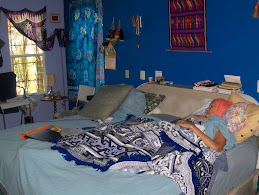
For us here on the beach, we have a wonderful breeze or wind that keeps us cool. It‘s a northwest wind that starts in the morning as a soft offshore breeze and picks up in the afternoon to a strength to create whitecaps. We also have an air conditioner in the bedroom which keeps us cool at night as well as on those hot afternoons when we want to siesta. Arturo insulated our house, so the bedroom cools quickly and stays cool. We haven’t gone in the ocean water yet. This is mostly because of being busy here at the house each day with organizing and hosting workers, friends, and their families. We are planning on boogie boarding soon. We are trying to be relaxed about everything, not rushing, and practicing letting go. Letting go is work for us Westerners, we don’t practice it much in the US, but here with the relaxed nature of the place it gets easier each day. The layers of worry and stress are melted by the sunshine and salt air and washed away by the sea breeze.
This part of Mexico during the summer lacks tourists, so one hears only Spanish spoken, which helps improve our Spanish skills. Also, the highways are less crowded, as are the restaurants and stores; and prices are lower, which happens as soon as the Americans and Canadians leave for the summer. However, many stores are closed as Mexican families take off for summer vacations. Driving through Cihuatlan today (Wednesday) we saw more closed stores than open ones. Mexicans love their holidays and vacations and love to go to the beach during these times, for example, Mother’s Day and Easter are two traditional beach days for many. School is now ending in Mexico and we will see more vacationers here in Tenacatita; often arriving in tour buses from as far away as Guadalajara for a day at the beach.
Work for Mexicans, such as building, is also slow during the summer, so it is easier to get hired help and professionals, maestros, such as plumbers and electricians. Our long distance from cities with maestros adds an extra burden for us in Tenacatita in trying to get professional help. If you find someone good, get his card and keep it handy. However, the language barrier has been somewhat of a problem in getting things done, but with some simple Spanish and sign language we have gotten understanding and things accomplished. When Sharon and I work as a team our understanding of Spanish increases a lot. But when we are really stumped we get one of our few English speaking Mexican friends to interpret.
Thursday, June 19, 2008
Puerto Vallarta

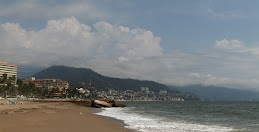
It was a stressful drive from Mazatlan to Puerto Vallarta taking about 8 hrs. The first half of the drive was on straight roads through agricultural lands, but the second half was tough. From Tepic to Puerto Vallarta the drive is not long, but it is on a slow downhill, curvy road that drops out of the Sierra Madres on to the plains of Puerto Vallarta. The drive took us through steep mountainous terrain covered in grasslands, and dense shrub covered hillsides. Just as we were getting tired, we rounded a curve and instantly we were dropped into a large verdant valley covered in palm trees and pastures. To the west we see La Bahia de Banderas (Bay of Flags) with it’s water glistening in the late afternoon sun, and in the distance, tucked away in the southern part of the valley right up against the mountains, is the famous city of Puerto Vallarta. As we reach Bucerias the traffic increases and so does the exhaust fumes, so that by time we reach Vallarta Sharon is breathing through her handkerchief. Unfortunately, the over-bearing exhaust fumes is the worst part of Vallarta. The offshore winds keep the exhaust fumes from the beach and the resorts, so these places are great, but walk the Malecon, or shop the markets and the fumes become overpowering.
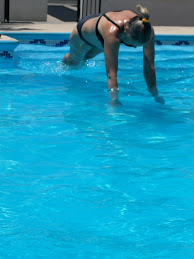
We spent most of our time at our resort, Canto del Sol, sleeping in, reading, and playing in the pool. The weather has been sunny and hot, with moderate humidity, but every afternoon thunder clouds build over the surrounding mountains and spill over the valley, cooling things off.. It won’t be long before the summer rains begin. I hope they hold out until we get to Tenacatita, it’s hard driving in heavy rains with thunder and lightning.
While in Vallarta we accomplished a bunch of other necessary things that can only be done in the larger cities of Mexico. In Vallarta there is a Costco, Home Depot, Walmart, and government offices. We had to update our FM3s, Mexican Passports, which is always an ordeal. To smooth out the process this year we hired a lawyer, which cost us $300. In this way we didn’t have to go to the government office, the lawyer will do it all and send our passports down to Tenacatita later on when he is all done. We decided to do it our self next year now that we understand the process. The passports are the process we use to get our Mexican citizenship, which comes after 10 years (it used to be 5 years) when we will have dual citizenship. In this way we can own our Mexican property outright without having to use a presta nombre (borrowed name), which is a very unusual process that I won’t get into here.
We also did our laundry, which is a small ordeal: We use unscented detergent and no dryer sheets, but in Mexico they use only scented products, so all their washing machines and dryers have an intense toxic smell to them. So whenever we wash our clothes in their machines they come back smelling awful. Lucky for us, we found a self-service Laundromat 20 minutes drive from Vallarta in a small shopping center at Paradise Village in Nuevo Vallarta. Interestingly, self-service Laundromats are uncommon in Mexico because most Laundromats are family run businesses where you bring your clothes in for washing.
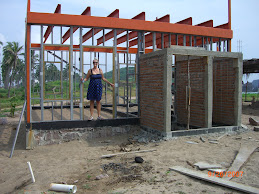
I spoke with Arturo, our builder, and he seems to believe the house will be done when we get there, although it sounds like nothing was done since leaving in March. No surprise! No less, we look forward to and are excited about getting to Tenacatita and moving into our house.
Oro Valley to Mazatlan

Today, June 9, we crossed. We went from a comfortable, knowing place (the US) to a strange world called Mexico. Today we crossed over to the uncertain. Mexico can be easy when relaxing in the sun along the beach or a pool; and it can be exasperating for instance when waiting endlessly in some government office, after having been there several times already. The crossing was very easy. We were not asked for ID, questioned, or searched. It was a slight maze of roads getting through but soon enough we were on Mexico highway 15 headed south through the Mexican state of Sonora. Sonora is applied named because it lies within the Sonoran Desert, the biologically most diversity desert in North America. I believe it has something to do with the greater amount of rainfall it receives . The area is dominated by numerous cactus species, saguaro, jumping cholla, prickly pear, and an abundance of shrub species.

San Carlos is a colorful, quiet village located at the end of the road on the Gulf of California. San Carlos caters to Americans and Canadians that winter down here, so it was very quiet this time of year. It seems to be a great place for fishing charters to catch marlin, dorado, tuna and other sport fishes. It was so relaxing at the Creston that we decided to spend an extra day, and make the long drive to Mazatlan in one day. It was a day well spent staying cool by the pool, because the next days drive was a long 11 hours.




















.JPG)